As the saying goes, all of us in Australia except the aborigines came from somewhere at some time.
My heritage in Australia is through my father’s line, is via a Lutheran Pastor Philipp and Sophie (nee Stamm) Oster, who sailed from Bremen, Germany in August 1847, arriving in Port Adelaide in December of that same year on board the Gellert, named, at the suggestion of Pastor Oster, after the 18th century German writer and poet.
Unfortunately, Philipp died on board the ship and was buried at sea. Sophie therefore arrived in Australia with her three surviving children (three child died in childhood) – Philipp, Pauline and Anna.
As things developed, the younger Philipp was the father of my grandmother, and his sister, Pauline, the mother of my grandfather. Yes, my grandparents were first cousins, which was quite common in those days.
For some time an historian in the Lutheran Church here in Adelaide has been pestering me to visit the Lutheran Archives to see the treasures that are held there on from the family. I finally made that visit before Christmas.

I couldn’t believe what we found. First, there was the ‘notebook’ of Sophie Amelie Stamm. She started the notebook in 1827, prior to her marriage to Philipp. This small, green leather-bound book with her name embossed on the spine – S. A. Stamm – was a joy to hold. I felt quite moved to hold in my hands a book that she had held and written in almost 200 years ago.
The writing is small, neat and somewhat faded. Some of the writings have been translated and they consist of jottings and some poetry. Shortly I will take the time to examine the translations more fully so I can gain some insight into her thoughts and feelings. She came from an educated and sophisticated life in Europe and, on arriving in Australia, found herself living in Lobethal in the Adelaide Hills in a pug and brick cottage that had been white-washed, of just two rooms with a lean-to added as the kitchen. Of the items the family brought with them from Europe, my daughter has a silver serving spoon, which sounds somewhat at odds with the structure in which it resided at Lobethal.

Philipp was 17 on the journey to Australia and he kept a diary of that voyage. It has been published and is a very moving account of the happenings during the five months at sea, including the death and burial of his own father. The Archives holds the original script together with numerous other diaries, letters, writings, etc of his accumulated over the period of his studies and ministry until his death in 1897.
Of particular interest to me was a small booklet that he had made for his sister, Pauline, in 1851 on the occasion of her confirmation. Philipp obviously took seriously the fact that he was, as the eldest child to act as loco parentis when required. It is bound with Pauline’s initials, P. R. O. on the front.
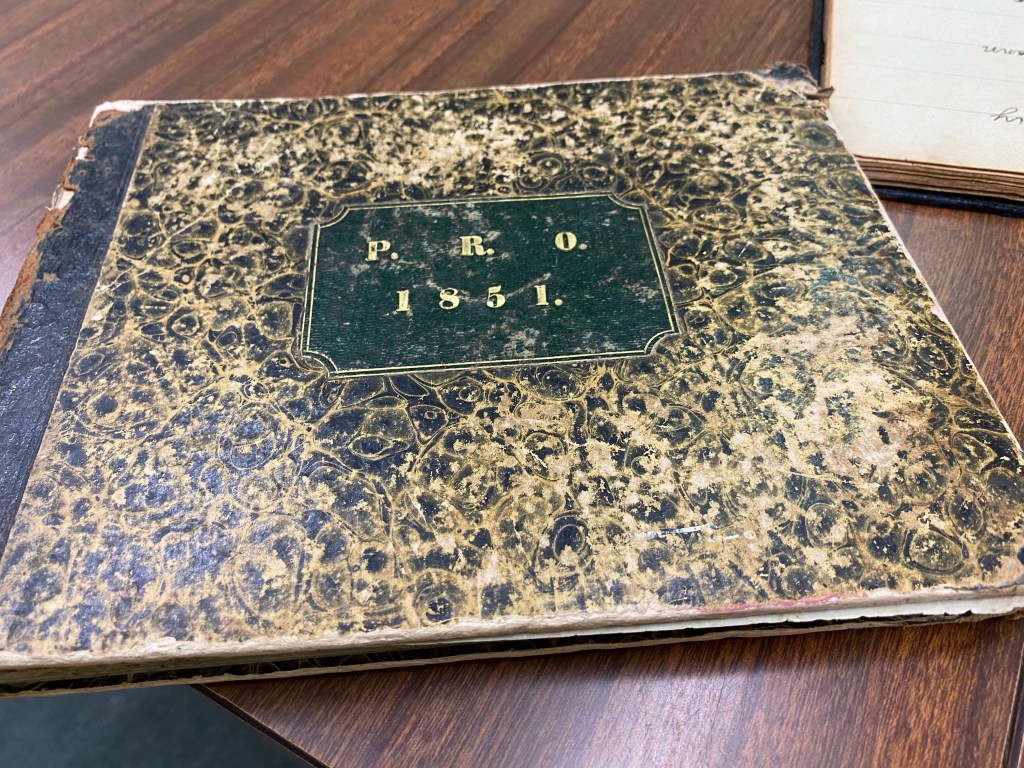
In his own hand, he prepared a manuscript for music, drawing the lines and then inserting the musical notes to numerous cantatas and motets of Bach and Haydn amongst others. This shows a commitment to family and also a love of music that was to stay with him throughout his life.
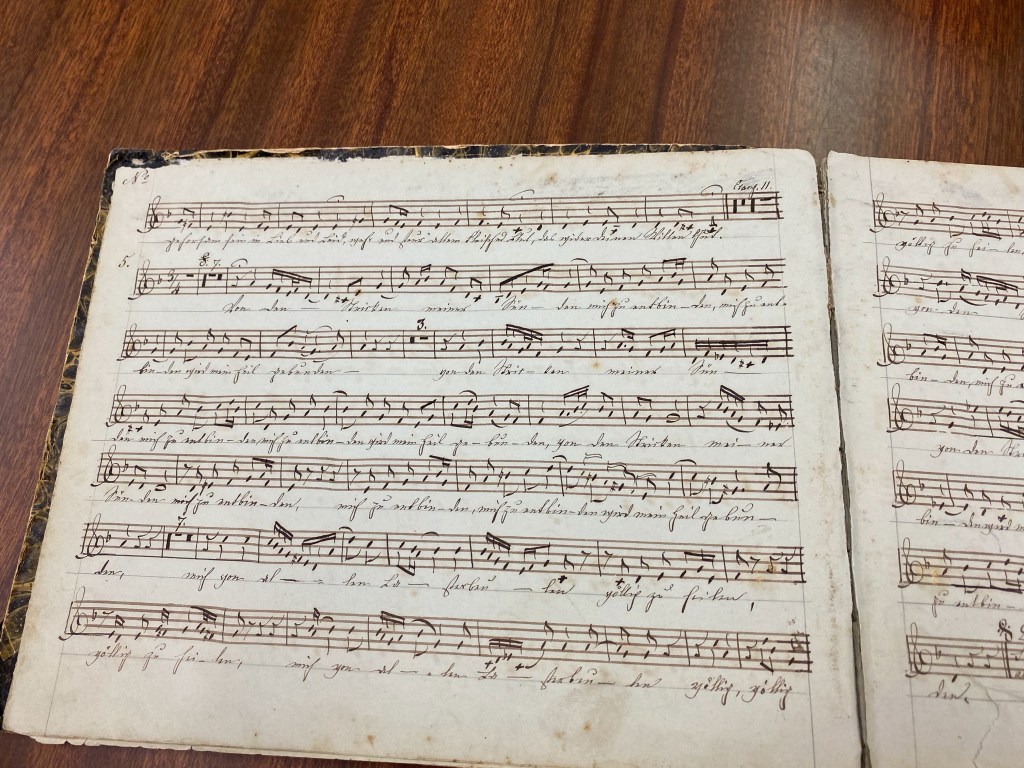
It was very personal to see these items in their own hands, an amazing legacy.
Anna, the youngest of the children, was also a diarist and the diary of Anna Ey of those early days in Australia has been printed a number of times and is being re-printed yet again due to demand.
An interesting find among the boxes was an autograph book that contains the original signatures of the first indigenous people to be confirmed at Kooniba on the west coast of South Australia.
These days, with so much of our writing being electronic, including this blog, we have lost some of the actual personality of our writings. We cannot see the actual hand, the corrections, the stains on the paper. This, I think, is a loss.
I would encourage any of my numerous cousins to visit the Lutheran Archives when in Adelaide to see for themselves the legacy they have left of the early days of settlement and the church in Australia.
 Faye Schmidt's Thoughts
Thank you Faye, for this story of your visit to the archives. Some lovely things for you discover.
LikeLike