When I sit now at my computer, working from a laptop that is linked to a large screen, keyboard and colour printer (that also scans), I can’t help but think back to the environment in which I worked in my first job as a Junior Secretary at the legal firm of Slater and Gordon. This is an old firm, and when I joined in 1963, both Mr Slater and Mr Gordon had long departed. In fact, the firm commenced in 1935 and is still going strong.
My pathway into the firm was by way of my English teacher at secondary school – John Ellis. It turned out that his mother was the Senior Secretary at Slater and Gordon and each year she was on the loo-out for outstanding commercial studies students to bring into the firm and train – and I struck it lucky. If you were going to be a secretary, legal secretaries were regarded as the best .
At the time I joined the firm, many of the partners were members of the Australian Communist Party and went on trips to China. I actually had the task of typing up the travel diary of one of the partners after his China trip and the main thing I can remember from it is that he was struck by how the Chinese people ate their orange peels!
They were also major players in the support of the labour unions and the introduction of workers’ compensation. It was not uncommon to receive a letter from the Victorian Railways Union that was addressed to “Dear Comrade ….”.
Anyhow, I have to say it was the best training I could have had. For the period, they really made sure that I learned all aspects of the firm before being assigned to a partner to actually work as a secretary.
Fisrt three months – Mail and associated tasks
This was all manual work. There were two deliveries each day and I also had to take two lots of mail to the Post Office each day.
Each envelope had to be opened carefully to make sure I didn’t cut in half a letter or document – it did happen! Then it had to be recorded in a ledger – date received, date of letter, sender, file number, subject, handling partner. This often meant checking various lists to check file numbers or who was handling the client. It was quite time consuming.
Once recorded, I then did my rounds where I distributed all the letters and collected any items that had to be posted or filed in any of the Courts of Government Offices, e.g. Lands Titles Office.
After that, Mrs Ellis who had oversight of me, would give me all the items I had to file from the previous day. She was the secretary to the Senior Partner, Mr Geoffrey Llewellyn-Jones. In those days we only referred to such people as “Mr” or “Mrs” – there was no casual use of first names in that environment.
It was then time to do the rounds and collect any further mail to go out that day and to record it all in the same way but as outgoing mail. We had a franking machine that enabled me to weigh and then punch the cost of the mail on the various envelopes prior to taking them to the Post Office. In those days the GPO would then provide me with an invoice that had to be paid within seven days.
By now it is lunchtime and I repeat the whole process all over again.
Second three months – Rounds
This I enjoyed – if the weather was fine! Slater and Gordon were located on the corner of Bourke and William Streets in Melbourne in a building known as St James Building. This location is central to the various courts, barrister’s rooms and other State Government offices.
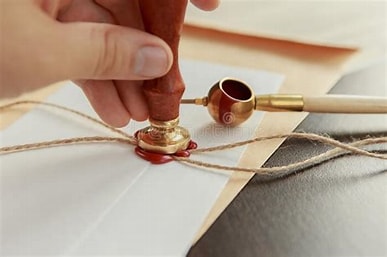
Many of the documents at the time required ‘sealing’. This meant using a very sharp spike to make holes in the left margin of a document and then threading either green or pink thread (depending on the document type) leaving two long threads to be then placed under seal. There was no way anyone could tamper with the document without it becoming obvious.
I became known in the firm for my expertise in sealing documents. There were no such things as staples or binders. Using the red wax with a lit taper that melted the wax, I then used the S&G metal stamp to seal the document. Later on, when I was producing my own documents, it provided me with real satisfaction to complete the process by stamping that seal in place – job done!
The firm was somewhat old-fashioned, particularly when we think this was the 1960’s. Whenever I left the office I was required to wear a hat and gloves. Having just left the school uniform behind, this grated somewhat, particularly if I didn’t bring any of my own items to work that day. They had a standard grey hat and gloves for winter and white hat and gloves for summer. I was continually having to take the white gloves home to be washed.
But this training was wonderful. I got to see how courts functioned, understand the role of the barrister and their relationship with the solicitor and client. I visited judge’s chambers and sat in the court room facilitating messages between parties. Seeing the connection between the different players and how the processes, related documents, etc all tied everything together was invaluable.
Third three months – Reception and Accounts
Now it was time to get to know the clients and also the different solicitors and the areas in which they worked. The main task I had to do while on the front desk was to type envelopes for Mrs Ellis and the occasional short letter that she would check. At last I was at least able to do some typing, even though it was minor.
My typewriter was an Olivetti – inked ribbon that was messy to change, noisy, tiring on the arms by the end of the day and no ability to correct any mistakes.

Again, this training was fantastic as I was able to meet and deal with all kinds of people in differing circumstances. There were the business people looking at a merger or buyout, those wanting to purchase property, family court matters, workers’ compensation or other injury related cases. How ignorant I was of the lives of others!
I shared this task with the main receptionist and in-between being at the desk, spent time in the Accounts Department. Here I recorded all incoming cheques in a register, prepared the documents for banking and wrote out the receipts. In addition, various solicitors would want cheques drawn to go out with mail or for a settlement meeting, and we would receive requisitions that we had to often decode from bad hand-writing and hand-write the cheques.
Final three months – Switchboard
O joy of joys! This was the hardest and most stressful task I ever had to do. Anyone who wanted to make a call, whether local, interstate or overseas, had to go through the switchboard. The solicitor would ring me and tell me who they wanted to speak to – often not providing a number, just a name. I had to find the relevant number, make the call, get the person on line and then link the external party to the solicitor. Incoming calls were the reverse.
It was a plug and cord switchboard.
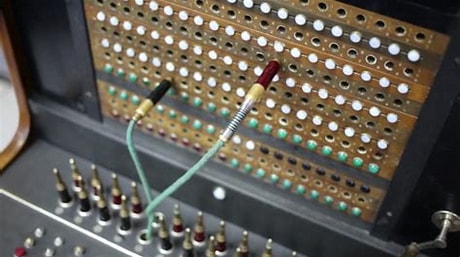
I hate to think of the number of times I put the wrong cord in the wrong spot!
Second year
Now I was deemed ready to actually be a junior secretary. I sat opposite Mrs Ellis and when requested would go into Mr Lewellyn-Jones’ office and take dictation by shorthand (Pitmans). While doing all the other tasks during my first year I was regularly required to practice my shorthand and typing so that I didn’t lose these skills. I really enjoyed this side of the work. Believe it or not, I can still do shorthand – but I can’t always read it back!
In these early days whenever I typed anything Mrs Ellis would check it before I took it in for signing. There was no such thing as a photocopier in those days, so we actually typed using carbon paper – yes we had carbon copies – the origin of the ‘cc’ that is still used today in emails. Mrs Ellis was so strict that she always read my work from the carbon copy, not the original. This showed up the evenness of my typing and whether I had erased any letters – it may have looked good on the original, but you can’t hid a correction of the carbon ink! If she saw just one correction, I had to type it again. Needless to say, I became a very good typist as it wasn’t worth handing Mrs Ellis anything with a typo in it.
After about six weeks I was assigned to work with Mr Richard Dunstan, the solicitor who headed up the Family Court division in the firm and to be junior to his secretary, a young married woman by the name of Jill Dixon. This was another great learning environment as Mr Dunstan had two Articled Clerks working with him (Law students in their final year) and they were also a lot of fun to be around after the strict environment of Mrs Ellis.
I owe a lot to all those who trained me at Slater and Gordon. One of the things I have never forgotten is to respect the chain of actions that lead to an outcome. I learned to write clearly when requesting a cheque, to give people plenty of time to respond when making a request, to give clear instructions when wanting something done – because I had been on the receiving end and knew what it was like to suffer from poor communication or direction. Also, it taught me to respect all those that played a part in an outcome. Everyone plays their part and there is no hierarchy of activities, just where the responsibility lies. Where would that important letter to a client be if the envelope was addressed incorrectly and they never got it?
 Faye Schmidt's Thoughts